AI-Driven Automated Bidding Strategies That Deliver Real Results in 2026
Posted on
March 24, 2026

.svg)

PPC bidding is no longer a game of manual adjustments and scattered optimizations. Campaigns now operate in auction environments shaped by changing demand, shifting user intent, device behavior, audience signals, location patterns, and constant competitive movement. That is too much for manual bidding to handle well at scale.
This is why AI-driven bidding strategies have become central to modern PPC performance. They help advertisers make faster, smarter bid decisions in real time while aligning spend with outcomes like lead quality, return on ad spend, and profit. But using automation is not enough on its own. The real difference comes from how well the system is trained, what data it receives, and whether the bidding setup reflects actual business value.
If you want a broader view of how automation is changing campaign execution beyond bidding alone, read our guide to AI-powered PPC. That article expands the conversation into targeting, campaign automation, creative testing, and AI-assisted optimization across paid media. (ViralGraphs)
This guide explains what AI-driven bidding strategies are, how they compare with manual bidding, which strategies improve ROI, where AI bidding fails, and which tools make sense for different campaign environments.

AI-driven bidding strategies are PPC bidding methods that use machine learning to adjust bids based on real-time and historical signals. Instead of relying on static bid rules or constant manual updates, these systems evaluate factors like device, location, audience behavior, time of day, competition, and past conversion patterns to decide how much to bid in each auction. Google describes Smart Bidding as a subset of automated bid strategies that uses Google AI to optimize for conversions or conversion value in every auction, using signals such as device, location, language, operating system, and time of day. (Google Help)
The goal is not just automation. The goal is better decision-making at scale.
A good AI bidding system can optimize toward cost per acquisition, return on ad spend, conversion value, lead quality, or profit-driven outcomes depending on how the campaign is configured. That gives advertisers a level of speed and flexibility that manual bidding cannot match in most active campaign environments. Google’s Target ROAS documentation also makes clear that value-based bidding works by predicting future conversion value and optimizing bids based on the value advertisers want to drive. (Google Help)
PPC campaigns now generate too many bid decisions for human teams to manage with consistency. Search, shopping, social, and retail ad environments all respond to real-time shifts in demand, intent, competition, and audience quality. Even strong PPC teams cannot adjust bids manually at the same speed that machine learning systems can.
The role of the PPC team has changed. The value is no longer in updating bids keyword by keyword. The value is in setting the right goals, assigning the right conversion values, maintaining data quality, and making sure automation is aligned with actual business outcomes.
That is the real shift. AI executes. People decide what success should mean.
Most serious advertisers already use some form of bid automation. That means the competitive edge no longer comes from simply enabling smart bidding. It comes from feeding the model better signals, structuring campaigns more intelligently, and auditing what the system is really optimizing toward.

AI bidding outperforms manual bidding in most medium and high-volume campaigns because it reacts instantly and processes more signals at once. It can evaluate auction-time patterns, adjust to user context, and adapt to changing performance trends faster than a person or team ever could. Google’s Smart Bidding documentation explicitly frames this as “auction-time bidding,” where bids are set for each individual auction. (Google Help)
This makes AI especially valuable for ecommerce brands, multi-location advertisers, SaaS companies with large lead flows, and accounts managing large product or keyword sets.
Manual bidding still makes sense in a few cases. A brand-new campaign with no reliable history may need controlled testing before automation becomes effective. Some low-volume or niche campaigns may not generate enough signals for AI to learn reliably. In certain edge cases, advertisers may also need manual control when campaign logic is highly specific and does not map cleanly to platform goals.
Manual bidding is not dead. It is just no longer the best default for most serious PPC programs.
The best model is usually not AI alone or manual alone. It is AI with human oversight.
The machine handles scale, speed, and live bid execution. The team handles conversion logic, exclusions, value assignment, testing, reporting, and business context. That is what strong PPC management looks like now.
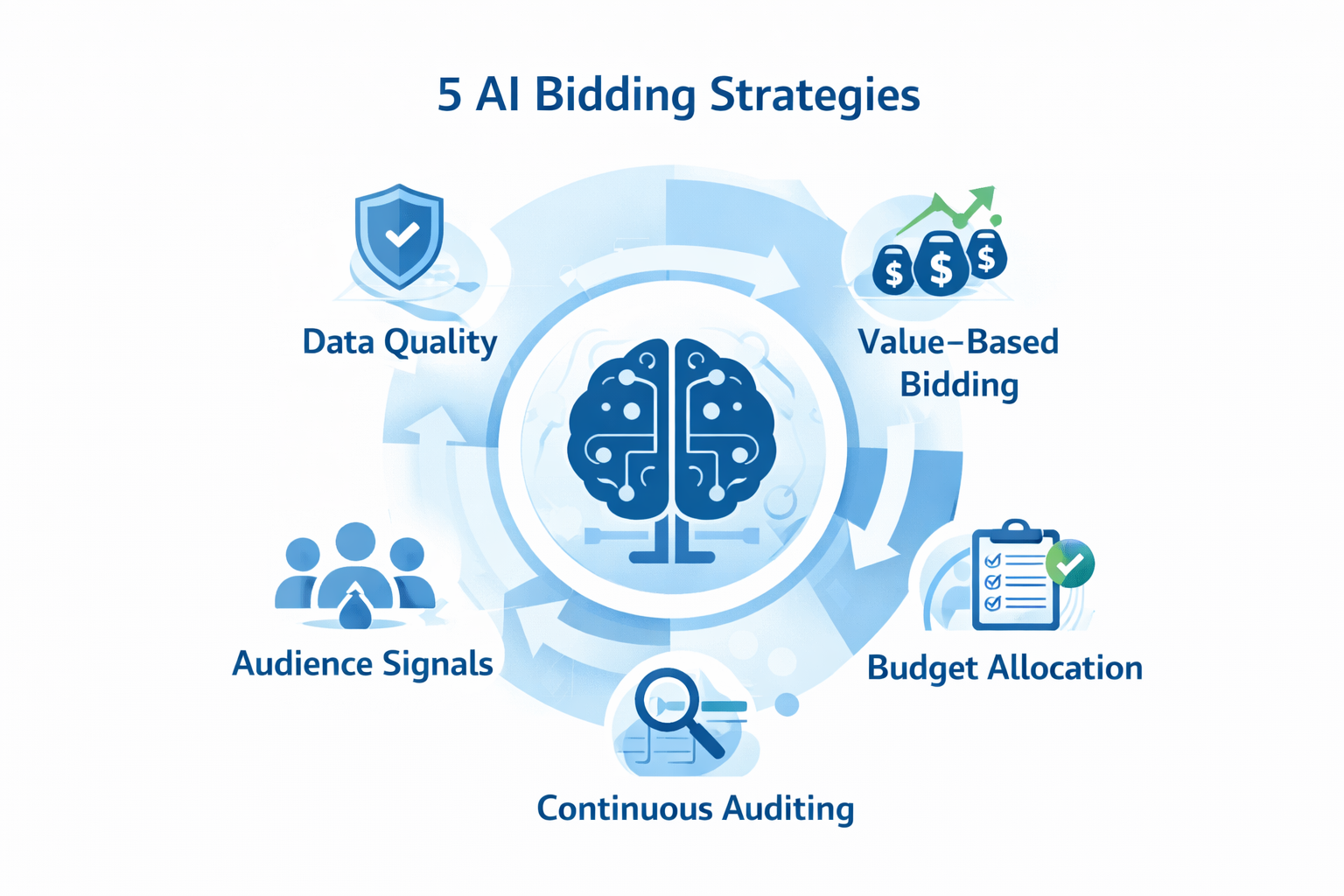
AI bidding depends on data quality. If conversion tracking is weak, values are inconsistent, or campaign structures are too fragmented, the system will optimize toward incomplete or misleading signals.
That is why the first real strategy is not a fancy bidding mode. It is building a reliable data foundation.
Start with strong conversion tracking. Make sure the platform is capturing the right actions, not just the easiest ones. If your sales cycle extends beyond the ad click, connect offline conversions where possible. If certain conversions matter more than others, make that visible in your setup instead of treating everything as equal.
Campaign structure matters too. Over-segmentation often hurts learning. When advertisers split campaigns into too many narrow groups, the model sees less data in each one and learns more slowly. Broader, cleaner structures usually give AI a better chance to identify meaningful patterns.
The learning phase also needs discipline. If you keep changing budgets, targets, and settings too quickly, you interfere with how the system stabilizes. Many advertisers do this, then blame automation for volatility they created themselves. Google notes that Smart Bidding models can be affected by major setting changes and need time to adjust when inputs shift. (Google Help)
A lot of advertisers still optimize for conversion volume when they should be optimizing for business value. That is one of the clearest gaps between average PPC management and mature PPC strategy.
Not every conversion has the same worth. A cheap lead that never closes is not equal to a smaller number of high-intent leads that generate real revenue. The same logic applies in ecommerce, where revenue alone can be misleading if margin differences are large across products.
Value-based bidding fixes this by telling the platform which conversions matter most. But the stronger version of this strategy goes beyond basic conversion value and moves toward profit-driven logic. That can include margin-based weighting, customer lifetime value models, or downstream sales quality signals imported back into the platform.
This is where AI bidding becomes more than automation. It becomes a business filter.
A SaaS company may assign higher value to demo requests from qualified segments instead of all form fills. An ecommerce brand may prioritize higher-margin categories instead of simply chasing top-line revenue. A service business may weight conversions based on actual deal size ranges rather than raw submission count. Google’s Target ROAS guidance supports this logic because it optimizes toward conversion value, not just conversion count. (Google Help)
Strong AI bidding is not just about what happens inside a campaign. It is also about how budget moves across campaigns, products, segments, and channels.
Predictive budget allocation helps advertisers shift spend toward the areas with the strongest incremental return instead of sticking to static budgets out of habit. This matters because demand does not stay still. Product categories rise and fall. Audience quality changes. Seasonal behavior shifts. Competitor activity changes auction pressure.
A campaign can look stable in a standard report while another begins to outperform because of a short-term demand spike or stronger conversion economics. AI-assisted budget allocation helps you respond earlier and more intelligently.
This works especially well in portfolio-style management where the goal is not to protect every campaign equally, but to move money toward the highest-value opportunities within a broader spend framework.
That does not mean giving the system unlimited control. It means setting governance at the portfolio level and letting the model optimize within those limits.
AI handles granular bid adjustments automatically, but that does not mean context stops mattering. Good advertisers still improve bidding performance by feeding the system better signals.
This includes first-party audiences, customer lists, value-based audience tiers, seasonality inputs, regional demand patterns, promotional periods, and major sales events. These inputs help guide the model toward the right type of conversion behavior instead of leaving it to infer everything on its own.
That is the real difference between generic automation and guided automation.
For example, if you know a promotion is coming, conversion behavior may spike outside normal patterns. If you know certain customer segments consistently drive higher-value purchases, those signals should influence the bidding environment. If some regions or devices behave differently during specific periods, that context should be reflected in the campaign strategy.
This does not mean returning to manual bid micromanagement. It means improving the intelligence around the system.
One of the biggest mistakes in PPC is assuming AI bidding is self-correcting by default. It is not.
Automation can drift toward the wrong signals. It can overweight weak conversions, spend too aggressively in low-quality segments, or follow recommendation logic that looks efficient on the surface but hurts business quality underneath. The more you trust it blindly, the more exposed you are to quiet underperformance.
That is why strong PPC teams audit AI consistently.
They review whether the system is buying the right kind of traffic, not just more traffic. They compare bidding modes, check whether conversion quality holds up as spend changes, examine where value is concentrating, and test whether platform recommendations actually improve outcomes. They also look for signs that the model is responding too aggressively to the wrong patterns.
The point is not to fight the machine on every move. The point is to make sure it is still optimizing toward the right target.

If tracking is incomplete, values are wrong, or offline conversion feedback never makes it back into the platform, AI bidding will optimize toward the wrong outcome. In many cases, it will do that faster than a human would.
Some campaigns simply do not generate enough meaningful data for the model to learn well. In those cases, full automation may underperform and a more controlled hybrid approach may make more sense.
Frequent budget changes, target changes, structure changes, and short-term panic decisions can keep the model from stabilizing. Advertisers often create this problem themselves by reacting too quickly to normal learning volatility.
If your bidding setup is optimized for the easiest conversion instead of the most valuable one, the platform may look efficient while hurting revenue quality. Lower CPA does not always mean better performance.
AI bidding works well when goals, values, and data are aligned. It struggles when they are not.
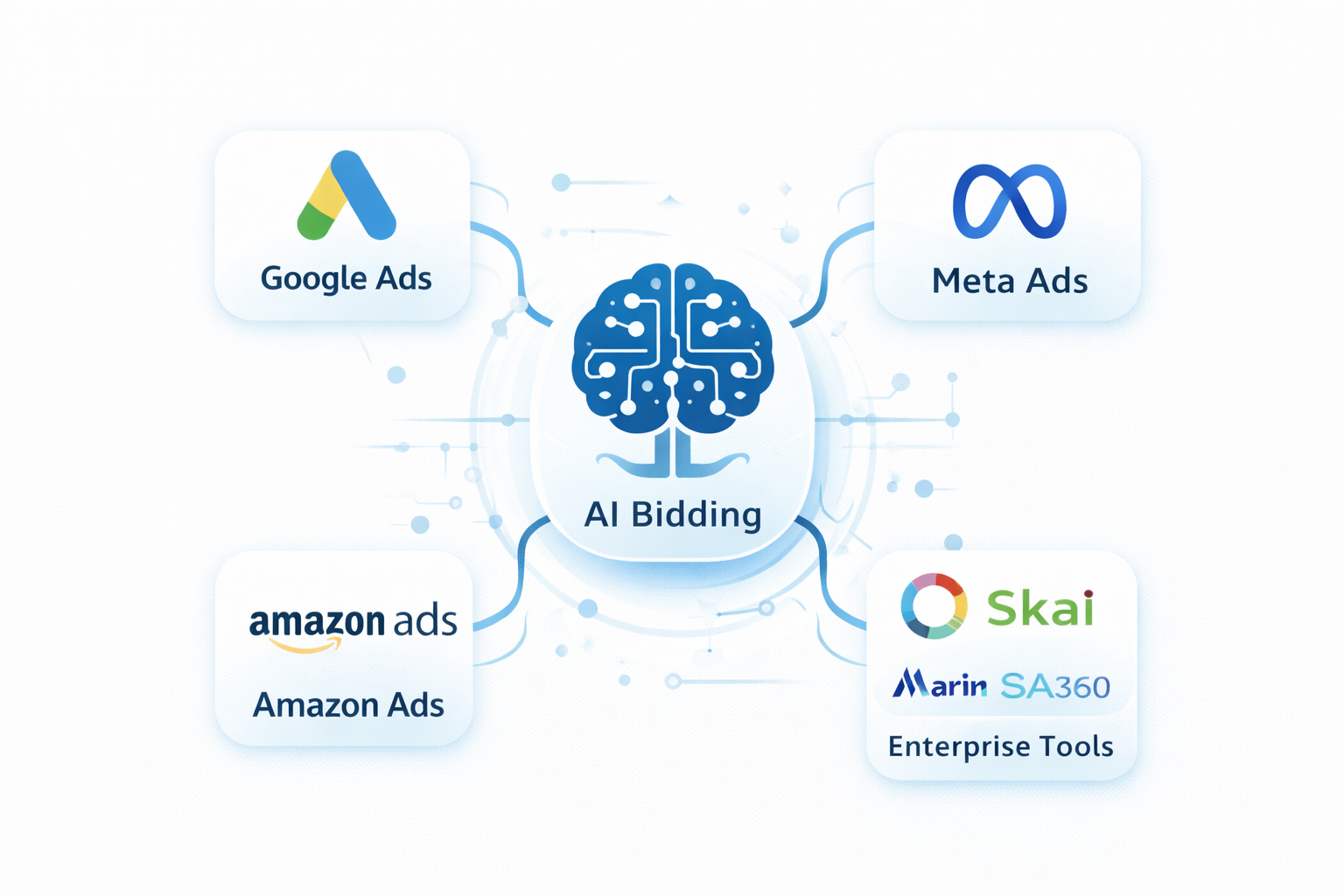
If most of your performance activity lives inside Google Search, Shopping, or Performance Max, Google Ads Smart Bidding is the obvious starting point. It works well when conversion tracking is strong and the campaign volume is high enough to support learning. Google positions Smart Bidding as an auction-time automated bidding system built for conversion and conversion-value goals. (Google Help)
Meta Advantage+ is built to automate more of the campaign setup and delivery process for sales and app campaigns. Meta says Advantage+ sales campaigns are designed to maximize performance with less setup time and greater efficiency, and Advantage+ campaign budget automatically manages campaign budget across ad sets to get the overall best results. (Facebook)
These platforms are better suited to larger advertisers that need broader budget pacing, portfolio management, and cross-channel control. They make more sense when the challenge is not just bidding inside one ad system, but coordinating spend across multiple environments at scale.
For brands competing inside Amazon’s marketplace environment, native Amazon bidding tools are often the most relevant option because they operate inside Amazon’s retail-specific auction and product discovery system. Amazon documents dynamic bidding options that raise or lower bids in real time based on the likelihood of a sale, with different bidding strategies suited to different campaign goals. (Amazon Ads)
For a broader look at how AI supports campaign automation, targeting, and testing beyond bidding logic alone, go back to our guide on AI-powered PPC. It complements this article well without duplicating it. (ViralGraphs)
Automation is not strategy. It is execution. Turning on smart bidding without defining value, exclusions, quality signals, and measurement logic is lazy management, not advanced PPC.
A lower CPA means nothing if the conversions are weak. This is one of the most common mistakes in AI-driven bidding setups. Teams optimize toward what is easy to measure, not what actually grows the business.
Many advertisers interfere too quickly, resetting learning and distorting performance. Then they blame AI for inconsistency that came from their own lack of discipline.
A sophisticated bidding model cannot rescue broken conversion logic. If the inputs are weak, the output will still be weak. It may just fail faster and at a bigger scale.
Start with conversion economics. If your business depends on margin, lead quality, repeat value, or a long sales cycle, your bidding strategy must reflect that reality. Volume alone is not enough.
Then look at data maturity. Accounts with clean tracking, enough conversion volume, stable campaign structure, and strong first-party data can use more advanced automation with confidence. Weak data environments need more caution and tighter control.
Finally, choose for business fit, not platform convenience. The best bidding strategy is not the one that sounds smartest or uses the most automation. It is the one that matches your reporting quality, budget flexibility, campaign volume, and growth objective.
The right strategy is the one most aligned with your business model and your measurement quality.

AI-driven bidding has become the default direction for scalable PPC, but enabling automation alone does not create better performance. What matters is the quality of the signals, the strength of the conversion logic, the discipline of the campaign structure, and the consistency of the audit process.
The advertisers getting the best results are not winning because they turned on Smart Bidding before everyone else. They are winning because they built systems that help AI make better decisions.
That means cleaner data, better value signals, stronger oversight, and less blind trust in platform automation.
If you want to turn AI bidding into a scalable acquisition engine, our performance marketing agency helps brands build data-driven PPC systems focused on conversion quality, ROI, and long-term growth. The service page is already positioned around paid media, CRO, ROI, and measurable growth outcomes, so it is the right BOFU destination from this blog. (ViralGraphs)
AI-driven bidding strategies use machine learning to adjust bids based on signals like device, location, audience behavior, time, and conversion likelihood. The goal is to improve bidding decisions at scale instead of relying on manual updates. Google’s Smart Bidding documentation is the clearest primary reference here. (Google Help)
In most medium and large campaign environments, yes. AI bidding usually performs better because it reacts faster and processes more signals than manual bidding can. Manual bidding still has value in low-volume campaigns, early testing phases, and some niche scenarios.
It needs accurate conversion tracking, enough signal volume, stable campaign structure, and reliable value inputs. If the data is weak or incomplete, the bidding system will optimize poorly.
Value-based bidding focuses on the quality and business value of conversions rather than just their total number. That value can be tied to revenue, profit, lead quality, or customer lifetime value depending on the business. Google’s Target ROAS documentation supports this framework. (Google Help)
That depends on campaign volume and stability, but the system usually needs enough time and enough consistent data to stabilize. Frequent changes during the learning phase can slow progress or reset it. (Google Help)
That depends on the campaign environment. Google Ads Smart Bidding is strong for Google-first advertisers, Meta Advantage+ helps with Meta automation, and enterprise teams often look at SA360, Skai, or Marin for broader control. Amazon’s native bidding tools are more relevant for marketplace-focused advertisers. (Google Help)
It usually fails when tracking is weak, goals are misaligned, budgets change too often, conversion values are wrong, or the campaign does not generate enough meaningful data for the model to learn properly.
.jpg)

%202.svg)


%202.png)
We offers a comprehensive suite of digital marketing services that cover all aspects of our online presence. From SEO and social media marketing to content creation and PPC advertising, they have the expertise and resources to handle our diverse marketing needs.


